The Lies That Bind by Kwame Anthony Appiah
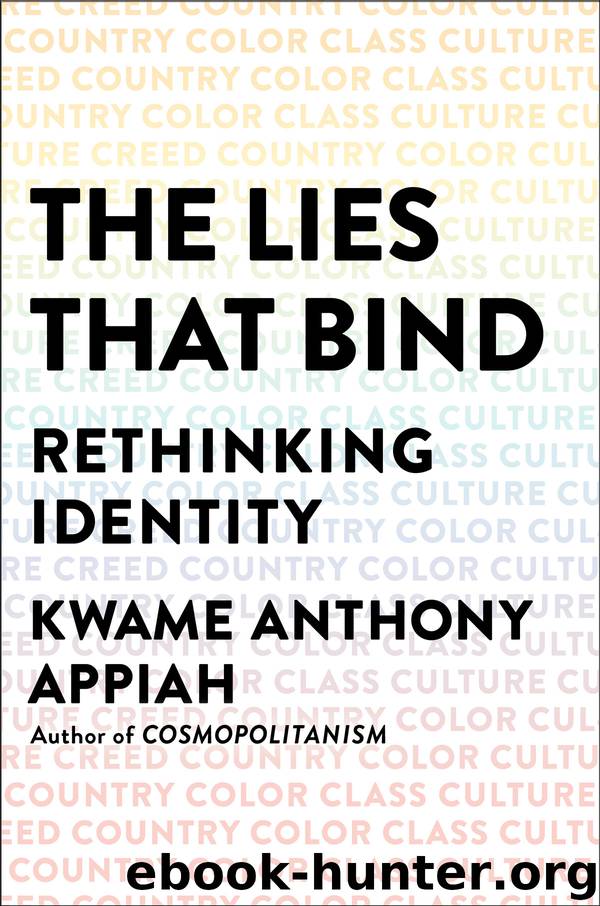
Author:Kwame Anthony Appiah
Language: eng
Format: epub
Publisher: Liveright
Published: 2018-08-01T16:00:00+00:00
COLOR INSIDE THE LINES
In the twenty-first century, one might have hoped to see signs that race thinking and the hostilities grounded in race—the problem of the color line—might be vanishing. Yet belief in an essential difference between Us and Them persists widely and continues to be thought by many to be inherited. And, of course, differences among groups defined by common descent can be the basis of social identity whether or not they are believed to be based in biology. As a result, ethnoracial categories continue to be important in politics at the national level, and racial identities shape people’s political affiliations.
Once ethnoracial groups are in place, inequalities between them, whatever their causes, provide bases for political mobilization. Many people now know that we are all, in fact, one species, and think that racial differences are, from a biological point of view, illusory; but that seldom undermines the significance for them of racial identities and affiliations. Around the world, people have sought and won affirmative action for their ethnoracial groups. In the United States, in part because of affirmative action, public opinion polls consistently show wide divergences on many questions along racial lines.33 On American campuses where the claim that “race is a social construct” echoes like a mantra, Asian, black, and white identities continue to shape social experience. Conversely (in part, I suspect, because essentialism is so natural to us), many people around the world simply couldn’t be persuaded that race, as we experience it in social life, is a “construct.”
When I think about why the racial fixation has proved so durable, I sometimes recall the lost-wax method by which goldweights in Ghana are cast. (You create a wax model, surround it with clay, and melt the wax away by pouring in molten brass.) In this case, the nineteenth-century race concept is the lost wax: the substance may have melted away, but we’ve intently filled the space it created. In the United States, nativists aim to define the country in terms of color and creed (namely, white and Christian). On the other side of the color line, the persistence of material inequality gives a mission to racial identities, for how can we discuss inequities based on color without reference to groups defined by color?
One reason race continues to play a central role in international politics, as well, is the politics of racial solidarity that Du Bois helped to inaugurate in the black world, in cofounding the tradition of Pan-Africanism. It shows up in diverse ways: African-Americans are more likely than whites to be interested in U.S. foreign policy in Africa; people in Port Harcourt, Nigeria, protested the 2014 killing of Michael Brown by a white police officer in Ferguson, Missouri; black Americans have a special access to Ghanaian passports; Rastafarianism in the Caribbean celebrates Africa as the home of black people; and heritage tourism from North and South America and the Caribbean to West Africa has boomed.34
But Pan-Africanism is not the only movement in which groups defined by common
Download
This site does not store any files on its server. We only index and link to content provided by other sites. Please contact the content providers to delete copyright contents if any and email us, we'll remove relevant links or contents immediately.
| Anthropology | Archaeology |
| Philosophy | Politics & Government |
| Social Sciences | Sociology |
| Women's Studies |
Nudge - Improving Decisions about Health, Wealth, and Happiness by Thaler Sunstein(7707)
The Fire Next Time by James Baldwin(5446)
iGen by Jean M. Twenge(5416)
Adulting by Kelly Williams Brown(4574)
The Sports Rules Book by Human Kinetics(4386)
The Hacking of the American Mind by Robert H. Lustig(4383)
The Ethical Slut by Janet W. Hardy(4253)
Captivate by Vanessa Van Edwards(3839)
Mummy Knew by Lisa James(3691)
In a Sunburned Country by Bill Bryson(3542)
The Worm at the Core by Sheldon Solomon(3487)
Ants Among Elephants by Sujatha Gidla(3467)
The 48 laws of power by Robert Greene & Joost Elffers(3291)
Suicide: A Study in Sociology by Emile Durkheim(3022)
The Slow Fix: Solve Problems, Work Smarter, and Live Better In a World Addicted to Speed by Carl Honore(3009)
The Tipping Point by Malcolm Gladwell(2922)
Humans of New York by Brandon Stanton(2873)
Get What's Yours for Medicare: Maximize Your Coverage, Minimize Your Costs by Philip Moeller(2732)
Handbook of Forensic Sociology and Psychology by Stephen J. Morewitz & Mark L. Goldstein(2705)
